Is the scholarship/opportunity offered annually?
Yes
What are the accepted subject areas?
Courses offered at one of the 60 participating Korean higher institutions
Which countries are eligible for the scholarship?
The Korean Government Scholarship is open to students from the following countries:
China, Japan, Russia, Cambodia, Mongolia, Vietnam, Mexico, India, Indonesia, Thailand, Laos, Malaysia, Philippines, Kazakhstan, Myanmar, Chinese Taipei, Uzbekistan, Turkey, USA, Ethiopia, Colombia, Nepal, Senegal, Bangladesh, Ukraine, New Zealand, Sri Lanka, Morocco, Azerbaijan, El Salvador, Egypt, Tanzania, Germany, France, Dominica, Chile, Iran, Canada, Democratic Republic of the Congo, Kyrgyzstan, Saudi Arabia, Singapore, Pakistan, Gabon, Romania, Belarus, Bulgaria, Slovakia, United Kingdom, Czech, Guatemala, Ecuador, Algeria, Yemen, Uganda, Belize, Honduras, Italy, Tunisia, United Arab Emirates, Poland, Ghana, Georgia, Greece, Guinea, Guinea-Bissau, NIGERIA, Republic of South Africa, Netherlands, Nicaragua, Democratic Republic of Timor-Leste, Rwanda, Libya, Lithuania, Moldavia, Bahrain, Barbados, Bahamas, Venezuela, Bolivia, Burkina Faso, Brazil, Brunei, Serbia, Seychelles, Sudan, Sweden, Slovenia, Armenia, Argentina, Haïti, Ireland, Afghanistan, Angola, Oman, Austria, Uruguay, Iraq, Israel, Zambia, Cameroon, Qatar, Kenya, Costa Rica, Cote d’Ivoire, Croatia, Tajikistan, Turkmenistan, Panama, Paraguay, Papua New Guinea, Peru, Fiji, Hungary, Australia, Jordan
Selection Procedure:
1st Selection
Applicants submit their applications either to the Korean Embassies around the world or to the partering universities in Korea. The embassies and universities select the successful candidates among the applicants in the 1st round of selection. The applicants of the successful candidates will then be forwarded to NIIED
2nd Selection
The NIIED selection committee selects the successful candidates among those who passed the 1st round.
3rd Selection
Among the successful candidates who have passed the 2nd round, the applications of those who applied through the Korean Embassies will be reviewed by universities for admission. Successful candidates must get admission from at least one of the universities.
Duration of Scholarship:
- 1 year Korean language course +2 year Associate degree
- 1 year Korean language course + 4 year Bachelors degree
- 1 year Korean language course+ 2 years of Master’s degree
- 1 year Korean language course + 3 years of Doctoral degree
To be taken at:
Korean Universities
How to Apply for the Korean Government Scholarship
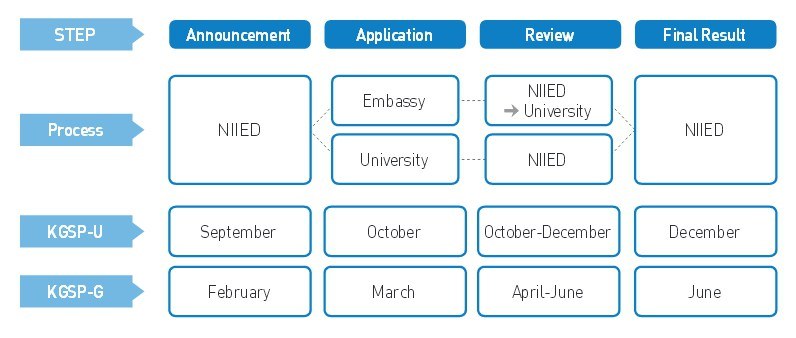
Submission of required documents, applicants should contact the appropriate Korean Embassy (or Korean Education Center) in the country of applicant’s origin (or in the neighboring country) or the designated regional university, the organization in charge of the 1st round of selection.
To be selected as a KGSP grantee, any applicant should successfully pass through the 1st selection process set by the Korean embassies of his or her origin.
So to apply for the program, please contact the 1st selection organizations to get detailed information on the 1st selection process such as application deadline and required documents, etc.
Applicants can only apply for the Korean Government Scholarship through the Korean Embassy in their home country or a participating Korean University.
For more information, visit this website.
Scholarship Webpage
About Korea
The Republic Of Korea is a small country on the far eastern edge of Asia. Although it ranks 109th in the world in terms of land area, the country is a center of economic activity, culture, and arts. Korea was colonized by Japan in the early 20th century and later had to endure the Korean War (1950-53), but it has achieved amazing economic growth in a short period, dubbed “the Miracle on the Han River.”

Seoul City, South Korea
Today, Korea is an industrial nation standing tall on the world stage. Its semiconductor, automobile, shipbuilding, steel making, and IT industries are on the leading edge in global markets. It hosted the 1988 Seoul Olympics and the 2002 Korea-Japan FIFA World Cup. More recently, Korean dramas, movies, and music are attracting many audiences in Asian countries and beyond, creating what is being called the “Korean Wave.” Korea’s new standing in the international community was highlighted in 2010 with the nation becoming the first Asian country to chair the G20 and host the G20 Seoul Summit.

